The Strange, Wonderful Freedom of Getting Really Good at Something Nobody Asked For
Let me tell you about Marcus.
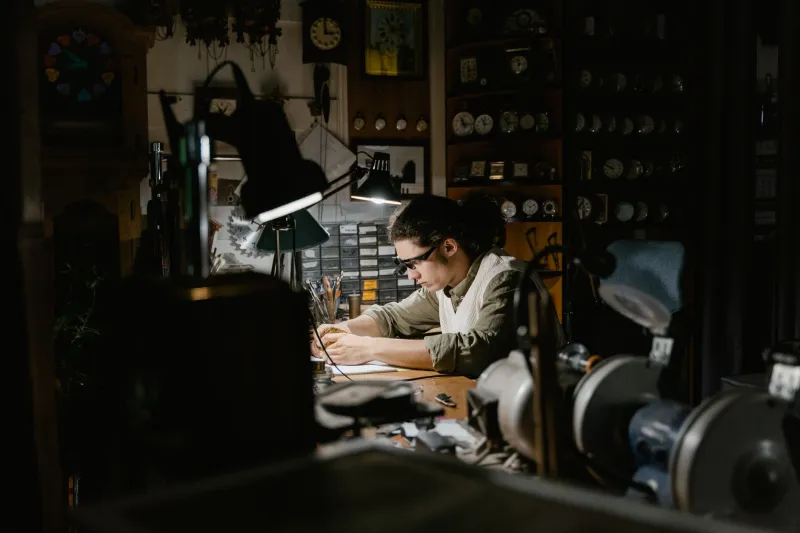
Marcus is a 38-year-old accountant from Columbus, Ohio. On weekends, he restores vintage mechanical typewriters. Not to sell them. Not to post them on Instagram for clout. Not because it's a lucrative side hustle. He does it because the click of a perfectly calibrated key on a 1956 Royal Quiet De Luxe is, in his words, 'the most satisfying sound in the world.'
His wife thinks it's a little weird. His coworkers don't really get it. And Marcus? Marcus has never been happier with a hobby in his life.
There's something happening here that's worth paying attention to.
The Problem With 'Useful' Hobbies
American culture has a funny relationship with free time. We've become so conditioned to justify our activities through the lens of productivity that even our hobbies are expected to pull their weight. We monetize them (the side hustle). We perform them (the Instagram feed). We optimize them (the training plan, the progress tracker, the goal-setting worksheet).
And when a hobby doesn't fit neatly into one of those boxes — when it's just something you love doing for no particular reason — it can feel almost... embarrassing to admit to.
But here's what the research, and a whole lot of quietly happy people, will tell you: the hobbies with no external payoff are often the ones that deliver the deepest internal reward.
Why Obscurity Is Actually a Superpower
Psychologists have a term for the kind of engagement that comes from doing something purely for the love of it: intrinsic motivation. And study after study confirms that intrinsically motivated activities produce higher levels of satisfaction, creativity, and well-being than extrinsically motivated ones — the kind driven by money, recognition, or social approval.
When nobody's watching, something interesting happens. The pressure evaporates. You stop performing and start actually doing. You're free to be a beginner without embarrassment, to be weird about the details nobody else notices, to care deeply about something that the rest of the world considers trivial.
That freedom is rare. And it turns out, it's also incredibly nourishing.
Take Denise, a 52-year-old teacher from Portland who spends her summers learning to identify every species of lichen in the Pacific Northwest. There's no lichen community cheering her on. There's no viral potential in a well-identified Lobaria pulmonaria. But she describes her time in the field as the most mentally alive she ever feels — a meditative, joyful state she can't replicate anywhere else.
Or consider the growing underground world of competitive rubber duck racing enthusiasts, amateur radio operators, antique button collectors, and people who dedicate serious hours to perfecting the art of paper marbling. These communities are small, deeply passionate, and by most measures, having an absolute blast.
The Psychology of 'Nobody Cares' (And Why It's Freeing)
Here's a counterintuitive truth: the absence of an audience can make an experience more meaningful, not less.
When you pursue something obscure, you sidestep the comparison trap almost entirely. There's no leaderboard for 'best amateur historian of 19th-century railroad dining cars.' There's no algorithm deciding whether your passion for hand-tied fishing flies is worthy of attention. You're operating completely outside the economy of likes, followers, and external validation.
What fills that space instead is something psychologist Mihaly Csikszentmihalyi famously called flow — that state of total absorption where time disappears and you're fully, completely present in what you're doing. Flow, it turns out, is one of the most reliable pathways to happiness that researchers have ever identified. And niche hobbies, with their intricate details and personal challenges, are flow machines.
When Marcus is elbow-deep in a typewriter mechanism, figuring out why the escapement isn't advancing correctly, he's not thinking about his mortgage or his inbox or whether he's living his best life. He just is. Fully. That's not nothing. That's actually everything.
Finding Your Weird Thing
If you're sitting here thinking I don't have a weird thing, you probably just haven't given yourself permission to explore one yet. Or you've talked yourself out of interests because they seemed impractical, niche, or hard to explain at dinner parties.
Some questions worth asking yourself:
- What did you love doing as a kid that you quietly abandoned because it wasn't 'serious' enough?
- What sections of a bookstore or library do you drift toward when nobody's directing you?
- What topics could you read about for hours without getting bored, even if they serve no professional purpose?
- What have you secretly found fascinating but never mentioned because it seemed too odd?
That last one is often the richest vein to mine.
The Permission Slip You Didn't Know You Needed
You do not need your hobby to be monetizable. You do not need it to be Instagrammable. You do not need it to make sense to your family, impress your colleagues, or contribute to any version of your five-year plan.
You just need it to light you up.
The world is full of people grinding away at 'productive' pursuits that leave them hollow. Meanwhile, Marcus is in his garage on a Saturday afternoon, listening to the perfect click of a restored typewriter key, grinning like a kid. He's figured something out that most people spend years looking for.
Your obscure, pointless, wonderful thing is out there. Go find it. Get good at it. Let nobody's opinion of it matter even a little bit.
That's not a waste of time. That's a life being fully lived.